
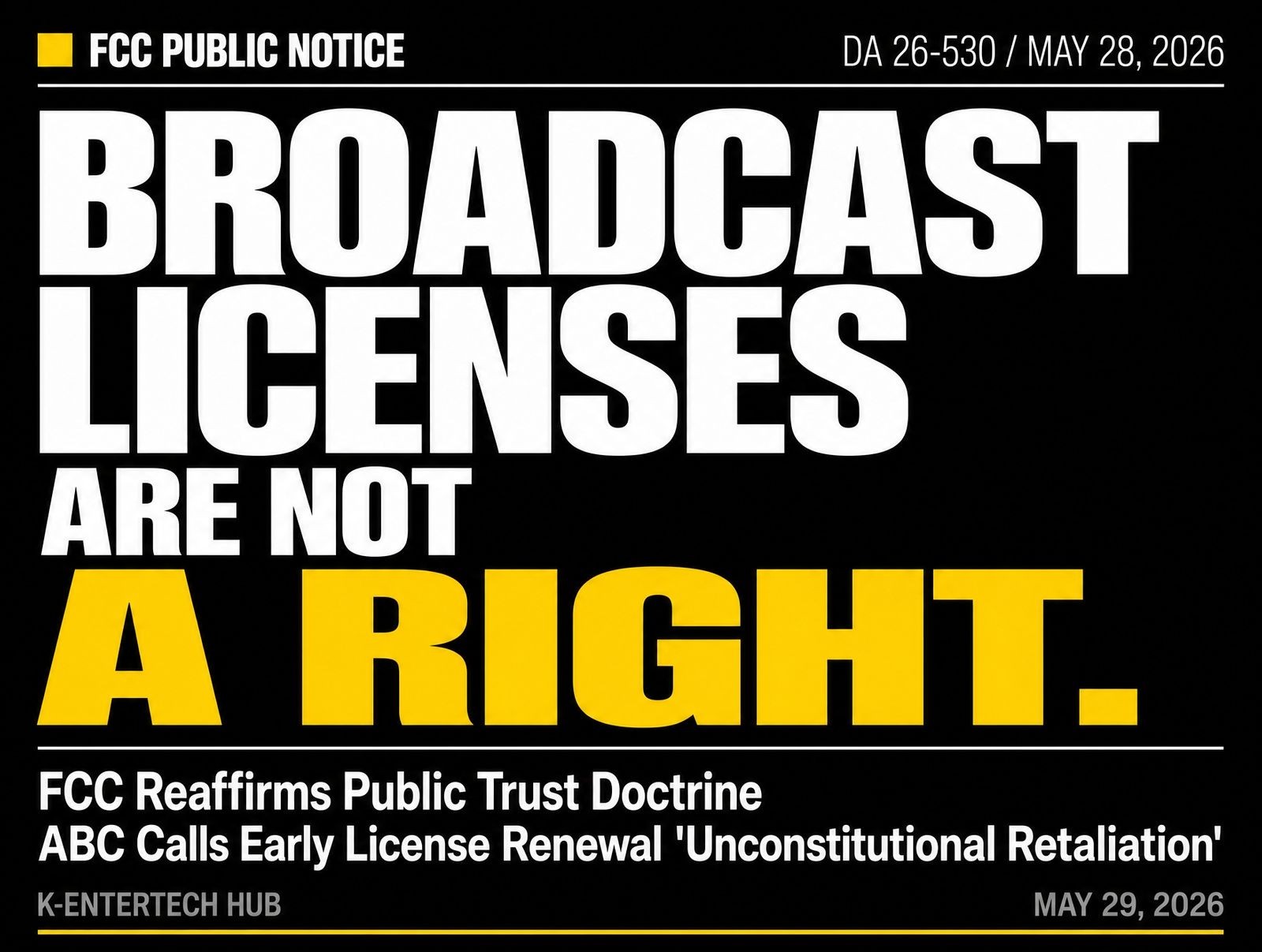
Public Notice DA 26-530 revives public-interest duties as ABC blasts an early license-renewal order as “unconstitutional retaliation”
The U.S. Federal Communications Commission has once again pushed to the center of its regulatory posture an old principle: a broadcast license is not property a company owns, but a public trust it is entrusted to operate for a limited term.
In a Public Notice issued May 28 (DA 26-530), the agency stated that “no broadcaster has a ‘right’ to use the public spectrum.” It warned that the licenses of operators who fail to adequately meet their public-interest obligations may be revoked, and that the spectrum could be reassigned to others who will faithfully carry out those duties.
The same day, Disney-owned ABC pushed back hard. After the FCC designated the licenses of its owned-and-operated (O&O) stations for early renewal, ABC publicly countered that the move was “unconstitutional retaliation and improper coercion.” The episode has once again surfaced the tension between the regulator and major broadcasters.
The reason a public-interest doctrine sustained for roughly a century is again being foregrounded as a regulatory instrument lies in the structural nature of broadcast spectrum. Spectrum is a physically scarce resource: only a limited number of channels can operate within the same market. That forces the government to grant one operator the right to use a frequency while excluding others.
Brendan Carr FCC Chairman
The institutional premise has long been that a broadcast license is not private property but something closer to a delegated authority to manage and operate a public resource for a defined period. In reaffirming this principle, the FCC signaled that a station’s very retention of its license can be at risk if it fails to provide content and service consistent with the public interest.
The move also intersects with a broader debate over how to redefine the public responsibility of traditional broadcasting in a media environment reshaped around digital platforms and streaming. How the contest between large media companies and the regulator over the boundaries of authority and accountability plays out is likely to shape both policy and industry structure.
A ‘Free-of-Charge’ Structure — the Basis for Public-Interest Duties
The FCC takes this asymmetry as the starting point of its regulatory logic. The notice points out that the same spectrum band can generate billions of dollars in value at auction, while broadcasters use it essentially for free. In exchange, the agency explained, broadcasters bear an obligation to operate in the public interest of the communities they serve. That sets broadcasting apart from other distribution technologies such as the internet and cable, which carry no direct FCC duty to meet the needs of a specific community.
The notice further stressed that Congress has imposed on licensees a duty to air programming responsive to local needs—programming that must serve the residents of the license area “not the private interests of national networks.” While the FCC has eased some formal burdens over the years, eliminating measures such as ascertainment and the main studio rule, it made clear that broadcasters’ status as public trustees has not been weakened.
Existing duties remain in force. Broadcasters must prepare and retain issues/programs lists in the online public inspection file, refrain from news distortion, and provide equal opportunity to political candidates. Prohibitions on obscene, indecent and profane content, as well as broadcast hoaxes, also continue to apply.
Where a broadcaster is found not to serve the public interest, the FCC said, it may impose a range of measures—enforcement actions, conditional or short-term renewals, orders to file early renewal applications, and designation for a hearing. The notice warned that the Commission “will not hesitate” to ensure broadcasters either meet their public-interest obligations or hand the privilege of a license to another operator who will.
This restatement of principle arose amid the collision with ABC. In April, the FCC ordered ABC to file early renewal applications years before its licenses expire. ABC argues that no such demand has been made in more than 50 years, and that the agency has never targeted an entire group of network-owned stations at once.
Filing its applications on May 28, ABC nonetheless stated it was submitting them “under duress” and argued that the timing “makes the retaliatory purpose
📎 Read full article on K-EnterTech Hub →
About K-EnterTech Forum · K-엔터테크포럼
K-EnterTech Forum (K-ETF, K-엔터테크포럼)은 엔터테인먼트 테크놀로지, K-콘텐츠, 한류, 미디어 정책 분야의 전문 인사이트를 제공하는 국내 대표 플랫폼입니다. K-팝·K-드라마·K-푸드·K-컬처와 AI·스트리밍·크리에이터 이코노미·방송 기술의 공진화(Co-Evolution) 전략을 연구하고, 국내외 포럼·행사를 통해 정책 및 산업 협력 의제를 이끌고 있습니다.
K-EnterTech Forum is Korea's leading platform for insights on entertainment technology, K-Content, Hallyu, and media policy — bridging Korean cultural industries with global technology trends.
고삼석 상임의장 · Chairman Samseog Ko
고삼석(Ko Samseog)은 K-EnterTech Forum 상임의장입니다. 동국대학교 첨단융합대학 석좌교수이자 국가인공지능전략위원회 분과위원으로, 30년 이상의 방송통신 정책 및 산업 경험을 바탕으로 K-콘텐츠와 글로벌 엔터테인먼트 기술의 융합을 선도하고 있습니다. 前 방송통신위원회 상임위원을 역임했으며, ZDNet Korea에 정기 칼럼을 연재 중입니다.
Samseog Ko is the founding Chairman (상임의장) of K-EnterTech Forum. He is a Distinguished Professor at Dongguk University and a member of Korea's National AI Strategy Committee. Former Commissioner of the Korea Communications Commission (KCC).
📩 familygang@naver.com | 🌐 entertechfrum.com | 고삼석 상임의장 소개 →