
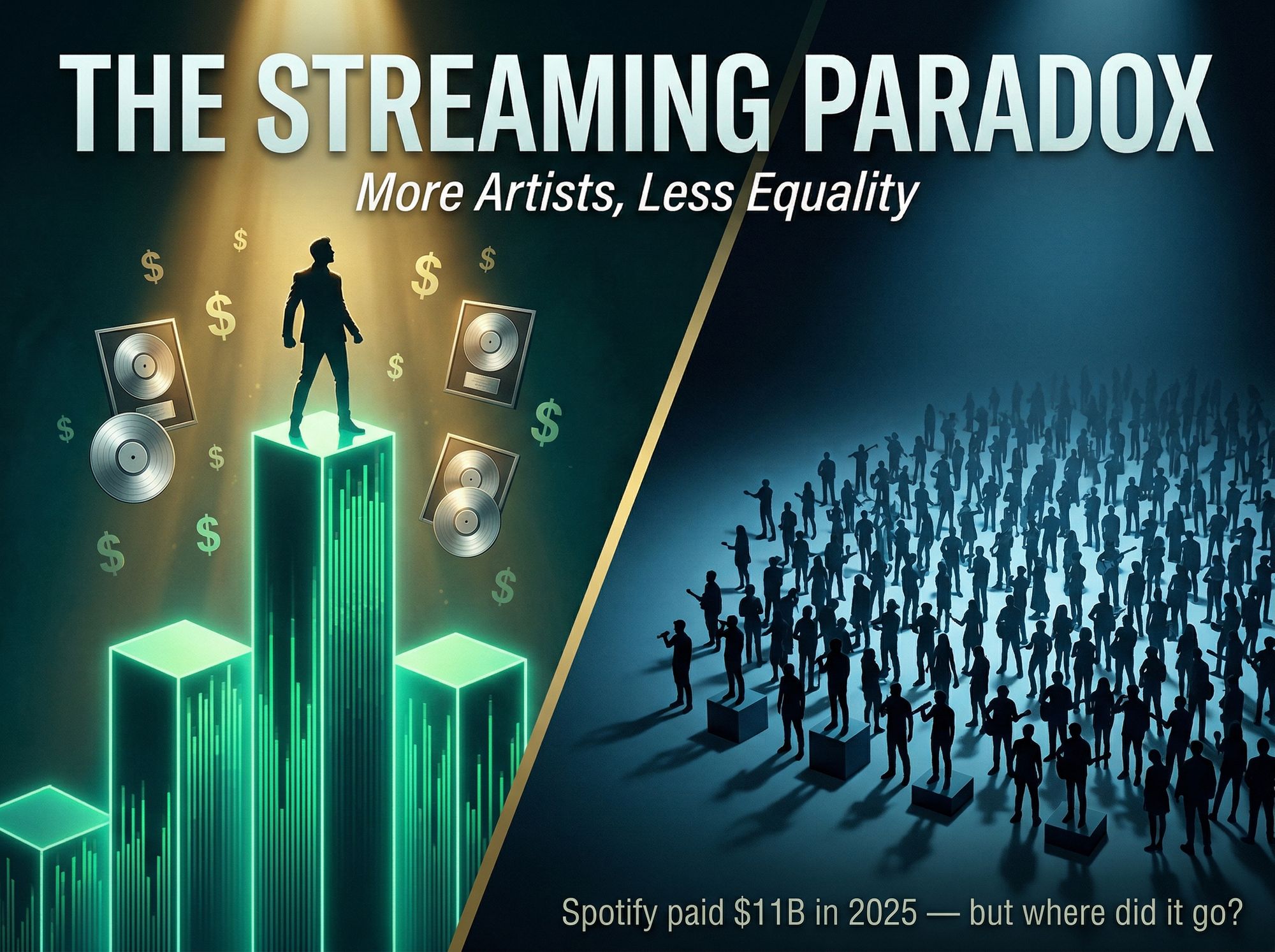
Subscription streaming platforms are expanding payouts to more music creators than ever before, but top artists still capture the vast majority of revenue.
The streaming era has made distribution and discoverability easier for a wider group of artists, but it has also reinforced the dominance of the biggest stars. The Pareto principle — which states that 80% of outcomes tend to come from 20% of inputs — is often referenced to describe the market share of top earners in a given industry.
"In music, it has always been much worse than that. And in the streaming economy, it's much, much, much worse than that."
— Larry Miller, NYU Steinhardt Professor of Music Business
State of Play: Spotify's Record Payouts
Spotify, which derives most of its revenue from paid subscriptions, has been critical in expanding the music pie for more artists globally.
Spotify paid a record $11 billion to the global music industry in 2025, up from $8.3 billion in 2024 and less than $1 billion in 2014.
More than 13,800 artists generated at least $100,000 a year from Spotify alone in 2024. Over 1,500 of those artists generated more than $1 million in royalties.
Music economist Will Page credits Spotify alone for over 40% of the global growth in record label revenue between 2014 and 2024.
Chart 1: Spotify's Share of All Global Record Label Payouts (2014–2024, estimated)AXIOS
But: Concentration at the Top Is Increasing
Even though more artists are making money from music than ever before, streaming has generally increased payout concentration at the top. The platform's global reach and algorithms amplify songs that are already popular, reinforcing the dominance of established stars.
Today, the 80 top artists on Spotify each earn more than $10 million annually from its platform alone.
The Big Picture: U.S. Streaming Revenues
Streaming is generally less lucrative for individual artists than physical sales (e.g., CDs), but more accessible to a wider group of creators.
For artists to make a substantial living, most need to invest in new forms of revenue such as concert ticket sales and merchandise.
Chart 2: U.S. Music Industry Streaming Revenues (2004–2025, adjusted to 2026 dollars)AXIOS
The U.S. contributes the most to subscription streaming revenues. There are over 106 million paid music streaming accounts in the U.S., making up roughly one-third of the global value of all music subscriptions.
📎 Read full article on K-EnterTech Hub →
About K-EnterTech Forum · K-엔터테크포럼
K-EnterTech Forum (K-ETF, K-엔터테크포럼)은 엔터테인먼트 테크놀로지, K-콘텐츠, 한류, 미디어 정책 분야의 전문 인사이트를 제공하는 국내 대표 플랫폼입니다. K-팝·K-드라마·K-푸드·K-컬처와 AI·스트리밍·크리에이터 이코노미·방송 기술의 공진화(Co-Evolution) 전략을 연구하고, 국내외 포럼·행사를 통해 정책 및 산업 협력 의제를 이끌고 있습니다.
K-EnterTech Forum is Korea's leading platform for insights on entertainment technology, K-Content, Hallyu, and media policy — bridging Korean cultural industries with global technology trends.
고삼석 상임의장 · Chairman Samseog Ko
고삼석(Ko Samseog)은 K-EnterTech Forum 상임의장입니다. 동국대학교 첨단융합대학 석좌교수이자 국가인공지능전략위원회 분과위원으로, 30년 이상의 방송통신 정책 및 산업 경험을 바탕으로 K-콘텐츠와 글로벌 엔터테인먼트 기술의 융합을 선도하고 있습니다. 前 방송통신위원회 상임위원을 역임했으며, ZDNet Korea에 정기 칼럼을 연재 중입니다.
Samseog Ko is the founding Chairman (상임의장) of K-EnterTech Forum. He is a Distinguished Professor at Dongguk University and a member of Korea's National AI Strategy Committee. Former Commissioner of the Korea Communications Commission (KCC).
📩 familygang@naver.com | 🌐 entertechfrum.com | 고삼석 상임의장 소개 →


