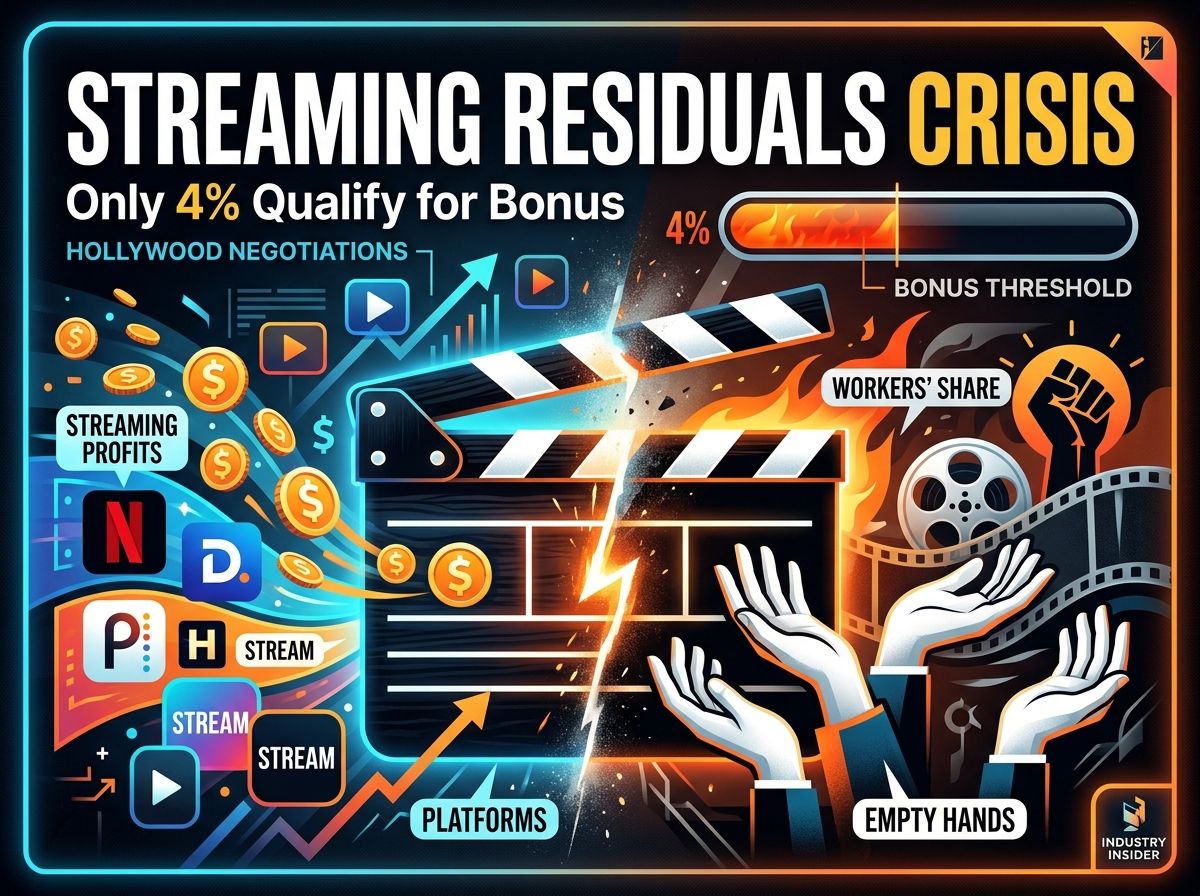
WGA and SAG-AFTRA negotiations near the finish line — streaming revenue-sharing reform emerges as the defining issue.
Fewer than 5% of streaming shows released in 2025 qualified for a performance bonus — and on Amazon, that figure dropped to just 1.5%. The data, compiled by audience measurement firm Digital-I, lays bare a harsh reality: the bonus mechanism secured by the Writers Guild of America (WGA) and SAG-AFTRA in their landmark 2023 contracts is failing to deliver meaningful compensation to the vast majority of content creators.
Three years after Hollywood ground to a halt in one of its most disruptive labor actions in decades, the industry is now navigating a new round of negotiations — and the structural inadequacy of streaming income distribution is back at the center of the debate.
No one in Hollywood wants another work stoppage. The WGA wrapped up its new deal with the studios ahead of schedule, and a SAG-AFTRA agreement appears imminent. While this round of talks has prioritized bread-and-butter issues — healthcare and pension benefits — the streaming pay problem has not gone away.
▲ [Bloomberg / Digital-I] Share of bonus-eligible titles that qualified for streaming performance bonuses in 2025
How the Bonus Works — and Why It Barely Triggers
Under the current agreements, a streaming performance bonus is only paid when a title is viewed by at least 20% of a platform's U.S. subscriber base within the first 90 days of release. The threshold was designed to reward genuine breakout hits — but in practice, it screens out nearly everything.
Platform | Qualified | Notable Titles |
Netflix | 26 | Happy Gilmore 2, Wednesday, Stranger Things, The Residence, The Electric State, etc. |
Amazon Prime Video | 5 | Reacher (only series) + 4 films |
HBO Max | 5 | Five series |
Disney+ | 2 | Two series |
Notably, Netflix should have delivered more bonuses than every other service combined, with 26 qualifying titles. But the list includes The Residence — canceled after one season — and The Electric State, widely considered a box-office disappointment. This exposes a flaw in the metric: the bonus threshold does not reliably track commercial success.
Two Paths for Reform
The unions have coalesced around two possible fixes: lower the qualifying threshold so more shows are eligible, or keep the threshold but dramatically increase the bonus amounts for those that do qualify. The WGA opted for higher payments. All eyes are now on whether SAG-AFTRA follows suit.
Each approach carries trade-offs. Widening eligibility spreads the benefit more broadly but dilutes the per-title payout. Raising the bonus amount rewards true breakout hits more generously, but leaves the vast majority of content — and the people who make it — without any additional streaming compensation. Either way, the current structure reflects and reinforces the winner-takes-all economics of the streaming era.
Netflix's Content Pullback Compounds the Problem
▲ [Bloomberg / Netflix & Chiffres] Netflix original film output by year, 2016–2026 Q1
The problem is compounded by a structural shift at Netflix itself. The platform released just 23 original films in the first quarter of 2026 — its lowest output since 2017 — down sharply from a peak of roughly 50 in 2022. The pivot toward quality over quantity means fewer titles in the pipeline, which mechanically reduces the number of programs even capable of qualifying for a bonus.
For the K-content industry, these developments carry direct implications. Korean production companies supplying content to global streaming platforms will need to monitor how bonus structure reforms reshape their deal terms. Meanwhile, the growth of alternative distribution models — particularly FAST (Free Ad-Supported Streaming TV) channels — may offer a more predictable revenue baseline that the current hit-or-miss bonus system cannot provide.
Sources: Bloomberg,
📎 Read full article on K-EnterTech Hub →
About K-EnterTech Forum · K-엔터테크포럼
K-EnterTech Forum (K-ETF, K-엔터테크포럼)은 엔터테인먼트 테크놀로지, K-콘텐츠, 한류, 미디어 정책 분야의 전문 인사이트를 제공하는 국내 대표 플랫폼입니다. K-팝·K-드라마·K-푸드·K-컬처와 AI·스트리밍·크리에이터 이코노미·방송 기술의 공진화(Co-Evolution) 전략을 연구하고, 국내외 포럼·행사를 통해 정책 및 산업 협력 의제를 이끌고 있습니다.
K-EnterTech Forum is Korea's leading platform for insights on entertainment technology, K-Content, Hallyu, and media policy — bridging Korean cultural industries with global technology trends.
고삼석 상임의장 · Chairman Samseog Ko
고삼석(Ko Samseog)은 K-EnterTech Forum 상임의장입니다. 동국대학교 첨단융합대학 석좌교수이자 국가인공지능전략위원회 분과위원으로, 30년 이상의 방송통신 정책 및 산업 경험을 바탕으로 K-콘텐츠와 글로벌 엔터테인먼트 기술의 융합을 선도하고 있습니다. 前 방송통신위원회 상임위원을 역임했으며, ZDNet Korea에 정기 칼럼을 연재 중입니다.
Samseog Ko is the founding Chairman (상임의장) of K-EnterTech Forum. He is a Distinguished Professor at Dongguk University and a member of Korea's National AI Strategy Committee. Former Commissioner of the Korea Communications Commission (KCC).
📩 familygang@naver.com | 🌐 entertechfrum.com | 고삼석 상임의장 소개 →


