
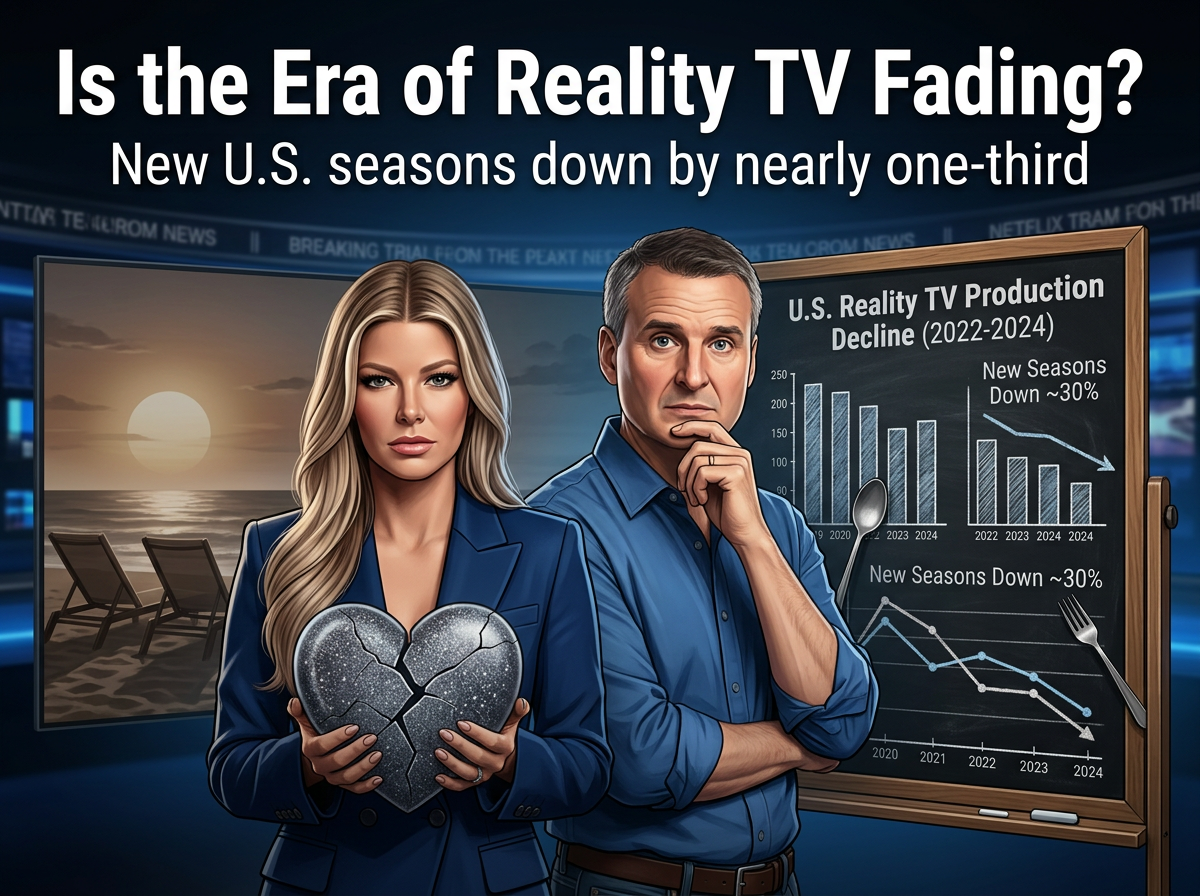
The number of unscripted series has plummeted by a third since 2022. As the industry rapidly changes — battered by cable's collapse, YouTube's rise, and relentless consolidation — an era is quietly vanishing.
American reality television is in freefall. Just 794 unscripted series launched new seasons in the United States last year — nearly a third fewer than in 2022, and down 15 percent in a single year alone. What was once the industry's lowest-risk, highest-yield format has been squeezed from three sides at once: the long structural collapse of cable, the unstoppable rise of YouTube as America's default screen, and wave after wave of mergers that have consolidated channels and production studios alike.
Cooking shows, home makeovers, true crime, travel — no subgenre has been spared. Veterans of the business are no longer asking whether this is a correction. They are watching an era end.
Reality TV Confronts a Harsh TV Reality
▲ Unscripted subgenre annual series volume, 2019–2025 Source: Luminate
MTV announced this month that Jersey Shore Family Vacation — a revival of the booze-soaked early-2010s reality franchise — would end after its ninth season. Months earlier, the network said it was canceling Catfish: The TV Show after nearly 300 episodes. HGTV has been on a cancellation spree of its own, axing Christina on the Coast and Bargain Block among others. Food Network, TLC and dozens of other cable outlets have followed suit.
Every show has an expiration date, of course. But the wave of cancellations rippling through the industry is not about individual programs aging out. It reflects something deeper: a structural fracture in the business that once made reality television so resilient.
The entertainment industry has spent enormous energy mourning the decline of scripted television. According to research group Luminate, the collapse of unscripted programming has been equally dramatic — and far less examined. As the chart above illustrates, virtually every major subgenre has declined sharply since 2022, with Food/Drink/Cooking, Crime, and Home Makeover/Real Estate among the hardest hit.
"There are fewer channels greenlighting fewer shows, and it all seems to be moving unstoppably to the bottom. Everything's contracting, and there are no new shows right now." — Mark Cronin, co-creator of Below Deck, Bravo |
Bright spots remain.
The Traitors and Love Island USA have been breakout hits. Thoroughbreds like the Housewives franchise, Below Deck and Survivor continue to draw audiences. Dancing With the Stars found a second wind through TikTok-fueled virality. But for every success, there is a stumble: a casting stunt for The Bachelorette backfired so spectacularly that ABC executives shelved an upcoming season outright.
Cable's Collapse, Streaming's Indifference
Paul Telegdy, former chairman of entertainment at NBC and a veteran of unscripted television, put it plainly: "There are so many things converging to squeeze the money for all practitioners." Industry executives point to three structural causes: the rapid decline of cable, the continued momentum of YouTube and other digital platforms, and the industry's seemingly endless consolidation.
Cable has dealt the most devastating blow. Even though reality series cost far less to produce than scripted dramas, sweeping budget cuts across cable networks have gutted production ambitions. HGTV had as many as 78 original unscripted series in 2019; last year that figure fell to 35. Food Network, which once produced roughly 70 reality shows a year, has seen its output halved. Output at Lifetime, E!, MTV and Oxygen has similarly cratered.
Streaming services have not filled the void. Hulu and Amazon Prime Video have modestly increased their unscripted totals in recent years, but Netflix's count actually declined last year. When writers and actors went on strike in 2023, many in the industry assumed studios would rush to commission reality series to fill the programming gap — much as they had during the 2007–08 labor stoppage. The buying boom never came.
The Gravitational Pull of YouTube
Chris Arundel, a longtime postproduction supervisor on Ghost Hunters and Wicked Tuna, began to sense the shift roughly three years ago. He watched colleagues who had never b
📎 Read full article on K-EnterTech Hub →
About K-EnterTech Forum · K-엔터테크포럼
K-EnterTech Forum (K-ETF, K-엔터테크포럼)은 엔터테인먼트 테크놀로지, K-콘텐츠, 한류, 미디어 정책 분야의 전문 인사이트를 제공하는 국내 대표 플랫폼입니다. K-팝·K-드라마·K-푸드·K-컬처와 AI·스트리밍·크리에이터 이코노미·방송 기술의 공진화(Co-Evolution) 전략을 연구하고, 국내외 포럼·행사를 통해 정책 및 산업 협력 의제를 이끌고 있습니다.
K-EnterTech Forum is Korea's leading platform for insights on entertainment technology, K-Content, Hallyu, and media policy — bridging Korean cultural industries with global technology trends.
고삼석 상임의장 · Chairman Samseog Ko
고삼석(Ko Samseog)은 K-EnterTech Forum 상임의장입니다. 동국대학교 첨단융합대학 석좌교수이자 국가인공지능전략위원회 분과위원으로, 30년 이상의 방송통신 정책 및 산업 경험을 바탕으로 K-콘텐츠와 글로벌 엔터테인먼트 기술의 융합을 선도하고 있습니다. 前 방송통신위원회 상임위원을 역임했으며, ZDNet Korea에 정기 칼럼을 연재 중입니다.
Samseog Ko is the founding Chairman (상임의장) of K-EnterTech Forum. He is a Distinguished Professor at Dongguk University and a member of Korea's National AI Strategy Committee. Former Commissioner of the Korea Communications Commission (KCC).
📩 familygang@naver.com | 🌐 entertechfrum.com | 고삼석 상임의장 소개 →


