Following the WGA, the actors’ union secures a longer contract and a sizable pension-fund infusion — averting a repeat of the 2023 dual strikes
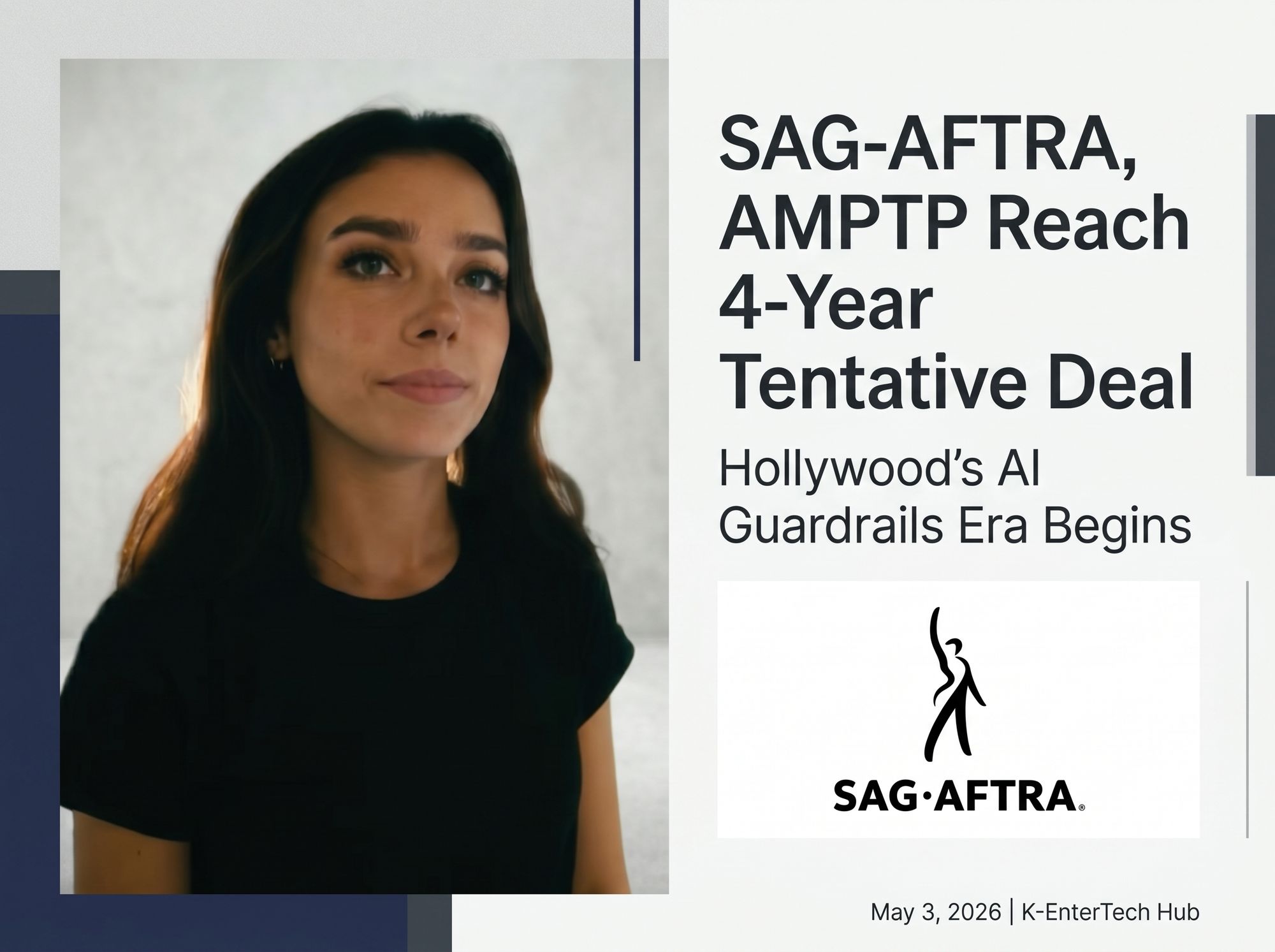
Bottom line — On May 2 (PT), SAG-AFTRA reached a tentative four-year master contract with the AMPTP. Following the Writers Guild of America (WGA), the actors’ union has now traded a longer contract term for fund contributions and tighter AI safeguards, effectively putting Hollywood into ‘no-strike’ mode. The only remaining piece is the Directors Guild of America (DGA), which begins its negotiations on May 11.
The significance of this agreement extends well beyond a routine labor settlement. Three structural pressures converged at once: the trauma of the dual 2023 strikes that froze the global content supply chain for nearly five months; an unprecedented post-streaming industry contraction; and the rise of fully synthetic AI characters symbolized by ‘Tilly Norwood.’ The studios won a longer period of labor peace; the unions secured thicker AI guardrails and stronger benefit funds. Both sides shared the same recognition — neither could afford another shutdown.
1. What Was Agreed — The ‘One More Year, Bigger Fund’ Formula, Repeated
In a joint statement, SAG-AFTRA and the AMPTP announced that they had reached a tentative agreement on terms for a successor contract to the 2023 SAG-AFTRA TV/Theatrical Contracts, covering motion pictures, scripted primetime dramatic television, streaming content, and new media.
Structurally, this deal mirrors the WGA agreement reached one month earlier. The standard three-year contract has been extended by a year to a four-year term — and in exchange, the union’s offset package has been enlarged.
- Contract term — Four years (extended from the standard three). Reflects the studios’ strong push for a longer guarantee of labor peace.
- Pension fund — A ‘sizable’ contribution from the AMPTP into SAG-AFTRA’s pension plan. Exact figures will not be disclosed until the union’s board reviews the terms.
- Comparison with WGA — The WGA received a $321 million infusion into its health fund in exchange for the same one-year extension. SAG-AFTRA’s pension contribution is expected to be on a comparable scale.
- AI protections — Strengthened consent and compensation provisions for ‘digital replicas,’ plus new ‘guardrails’ targeting fully synthetic performers.
- Streaming residuals — Higher bonus payments for performers on hit streaming titles, partially addressing actors’ long-running complaint that streaming residuals are a fraction of traditional broadcast and syndication payouts.
The tentative agreement still requires approval by the SAG-AFTRA national board and ratification by the membership before taking effect. The union said full terms would not be disclosed until the board reviews the deal, which is expected within the coming days.
2. Why It Closed Quickly — Three Structural Pressures
The current SAG-AFTRA contract does not expire until June 30. The deal effectively closed two months ahead of the deadline. The reason this round of bargaining wrapped up so quietly lies in an industry environment radically different from 2023.
① Lessons from the 2023 dual strikes — The simultaneous WGA and SAG-AFTRA strikes paralyzed production for nearly five months and inflicted severe costs on both sides. A shared ‘never again’ mindset shaped this round of talks from the start.
② Global contraction of the content industry — Post-streaming reductions in content investment, accelerated M&A, and ongoing layoffs forced unions to recalculate the cost of a strike. The fact that bargaining began on February 9 — five months before contract expiration — itself signaled both sides’ desire for a relaxed, deadline-free settlement.
③ The DGA timetable — The AMPTP needed at least a week to prepare for May 11 negotiations with the directors’ guild. Without a SAG-AFTRA agreement by this past weekend, talks would have had to be suspended and resumed in June. On Saturday, May 2, the AMPTP reportedly ‘sweetened’ its offer to seal the deal under that calendar pressure.
3. The Real Battleground — The ‘Tilly Norwood Clause’
The single most contentious issue in th
📎 Read full article on K-EnterTech Hub →
About K-EnterTech Forum · K-엔터테크포럼
K-EnterTech Forum (K-ETF, K-엔터테크포럼)은 엔터테인먼트 테크놀로지, K-콘텐츠, 한류, 미디어 정책 분야의 전문 인사이트를 제공하는 국내 대표 플랫폼입니다. K-팝·K-드라마·K-푸드·K-컬처와 AI·스트리밍·크리에이터 이코노미·방송 기술의 공진화(Co-Evolution) 전략을 연구하고, 국내외 포럼·행사를 통해 정책 및 산업 협력 의제를 이끌고 있습니다.
K-EnterTech Forum is Korea's leading platform for insights on entertainment technology, K-Content, Hallyu, and media policy — bridging Korean cultural industries with global technology trends.
고삼석 상임의장 · Chairman Samseog Ko
고삼석(Ko Samseog)은 K-EnterTech Forum 상임의장입니다. 동국대학교 첨단융합대학 석좌교수이자 국가인공지능전략위원회 분과위원으로, 30년 이상의 방송통신 정책 및 산업 경험을 바탕으로 K-콘텐츠와 글로벌 엔터테인먼트 기술의 융합을 선도하고 있습니다. 前 방송통신위원회 상임위원을 역임했으며, ZDNet Korea에 정기 칼럼을 연재 중입니다.
Samseog Ko is the founding Chairman (상임의장) of K-EnterTech Forum. He is a Distinguished Professor at Dongguk University and a member of Korea's National AI Strategy Committee. Former Commissioner of the Korea Communications Commission (KCC).
📩 familygang@naver.com | 🌐 entertechfrum.com | 고삼석 상임의장 소개 →
![[긴급 모집] 美 플로리다 Early Stage Venture Conference 2026 한국 기업 참가사 공모](https://cdn.media.bluedot.so/bluedot.kentertechhub/2026/05/do2kax_202605172336.jpg)