Korean Wave strategy pivots from content export to offshore production infrastructure; deal framework to be finalized at ATF Singapore in December
The Infocomm Media Development Authority of Singapore (IMDA) and Korean terrestrial broadcaster SBS signed a memorandum of understanding in Seoul on April 21 to jointly develop global content and AI media solutions — a deal that marks a decisive shift in Korean broadcasters’ international strategy from finished-content export toward offshore co-production infrastructure.
The move reflects three structural pressures converging on Korea’s terrestrial networks at once: a saturated domestic advertising market, rising production costs that single-market financing can no longer absorb, and intensifying AI-driven localization competition.
Singapore, having spent more than a decade building public-funded co-production incentives, ASEAN distribution reach, and an English-language market gateway, has emerged as the preferred partner for Korean broadcasters seeking a second regional production hub.
Because the agreement engages both sides at the project-origination stage rather than at the licensing stage, it stands out as a symbolic inflection point in a three-decade Hallyu history that has until now been defined by downstream distribution deals.
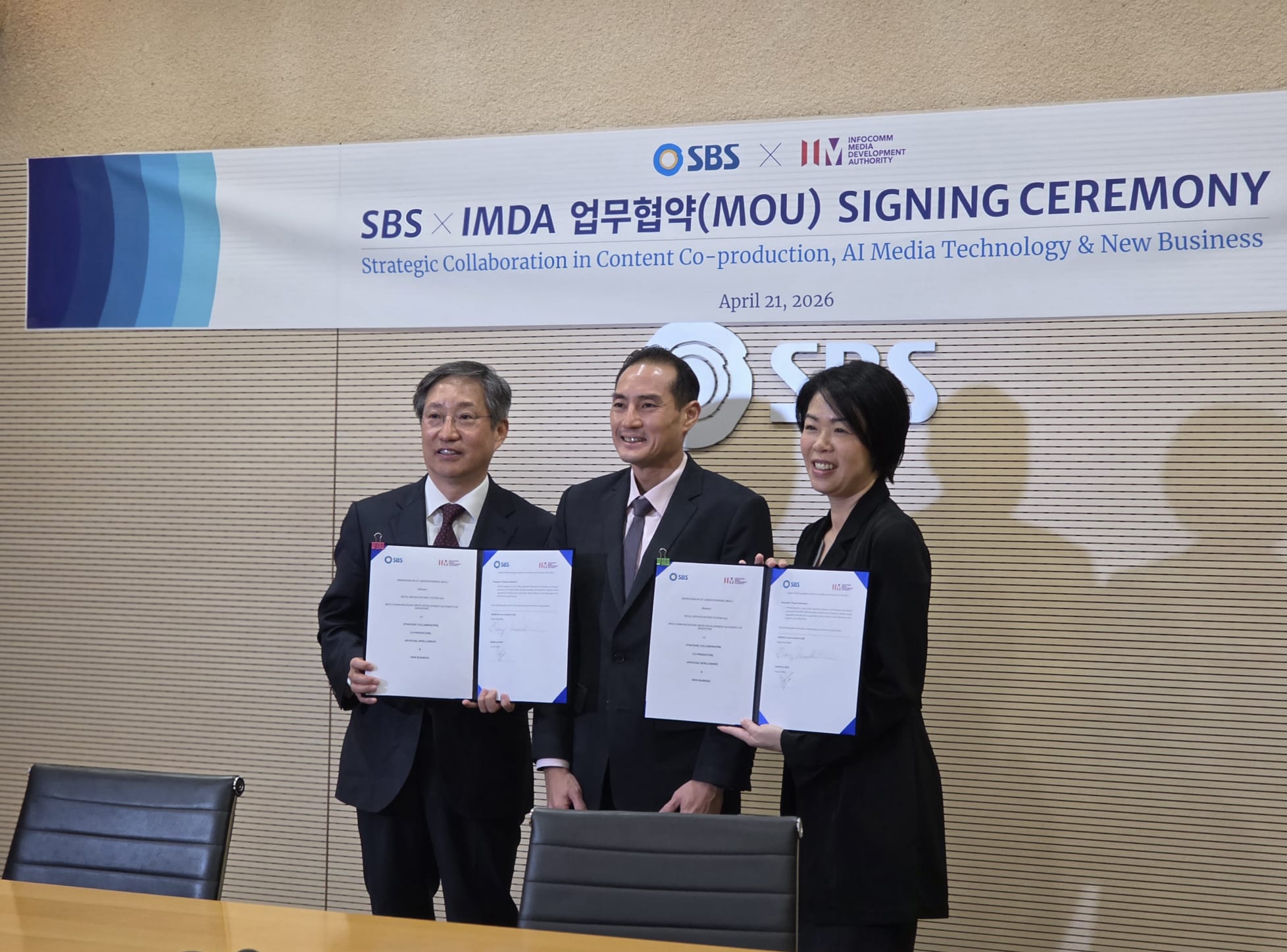
Left to right: Mr Moonshin Bang, President & CEO of SBS; Mr Tan Kiat How, Senior Minister of State for Digital Development and Information, Republic of Singapore; Ms Yvonne Tang, Assistant Chief Executive, Media Industry Group, Infocomm Media Development Authority of Singapore
The Signing | Ministerial-Level Witness During Seoul Learning Trip
The MOU was signed in Seoul on April 21, with Tan Kiat How, Singapore’s Senior Minister of State for Digital Development and Information, witnessing the ceremony. Bang Moon-shin, President and Chief Executive Officer of SBS, signed for the Korean side, while Yvonne Tang, Assistant Chief Executive of IMDA’s Media Industry Group, signed for Singapore. The ceremony was held during an IMDA-led industry learning trip to Seoul, underscoring that the partnership is policy-anchored rather than a stand-alone corporate transaction.
Scope | End-to-End Value Chain, from Long-Form Drama to Micro-Drama
The agreement covers the full content value chain — development, production, post-production, and cross-border distribution — and spans long-form dramas, variety shows, micro-dramas, and non-fiction formats. The language of the MOU signals an explicit move beyond per-title licensing toward joint development at the concept stage.
SBS brings a proven global IP catalogue that has reached an estimated 300 million viewers in more than 190 countries through Netflix, Disney+ and VIU, anchored by titles including Running Man, My Love from the Star, and Business Proposal. Singapore, through its Made-with-Singapore framework and co-funding instruments, has positioned itself as Asia’s most institutionalized co-production hub.
The partnership is designed to combine those assets at the point where the greatest financial risk and creative leverage reside — project origination.
A welcome message for the Singaporean delegation on display in the lobby of the SBS headquarters in Seoul
AI Collaboration | Localization, Automated Post, and Creation Tools
A central technical pillar is joint development of AI-driven media solutions, with three areas flagged: multilingual localization (dubbing and subtitling), automated post-production workflows, and AI-enabled content creation tools. Joint pilot projects and training programs are envisioned to accelerate technology adoption on both sides.
SBS CEO Bang Moon-shin indicated that pairing SBS’s production capabilities with AI-based multilingual service delivery will extend the network’s reach and competitiveness across ASEAN and global markets. Yvonne Tang of IMDA framed the tie-up as a combination of the Korean Wave’s global pull with Singapore’s function as an international co-production and innovation hub.
Structural Context | Why IMDA–SBS, and Why Now
Industry analysts read the MOU as a structural pivot rather than a routine bilateral deal. Three pressures are working simultaneously on Korea’s terrestrial sector.
First, the Korean terrestrial advertising model has plateaued. Shrinking domestic ad revenue and rising production costs have together made dual monetization — pairing domestic ad income with international co-production and distribution revenue — an operational necessity rather than an option. Co-production redistributes upfront production risk while securing downstream international yield.
Second, Singapore’s IMDA has built the most institutionalized co-production stack in Asia, combining funding schemes, tax incentives, and a co
📎 Read full article on K-EnterTech Hub →
About K-EnterTech Forum · K-엔터테크포럼
K-EnterTech Forum (K-ETF, K-엔터테크포럼)은 엔터테인먼트 테크놀로지, K-콘텐츠, 한류, 미디어 정책 분야의 전문 인사이트를 제공하는 국내 대표 플랫폼입니다. K-팝·K-드라마·K-푸드·K-컬처와 AI·스트리밍·크리에이터 이코노미·방송 기술의 공진화(Co-Evolution) 전략을 연구하고, 국내외 포럼·행사를 통해 정책 및 산업 협력 의제를 이끌고 있습니다.
K-EnterTech Forum is Korea's leading platform for insights on entertainment technology, K-Content, Hallyu, and media policy — bridging Korean cultural industries with global technology trends.
고삼석 상임의장 · Chairman Samseog Ko
고삼석(Ko Samseog)은 K-EnterTech Forum 상임의장입니다. 동국대학교 첨단융합대학 석좌교수이자 국가인공지능전략위원회 분과위원으로, 30년 이상의 방송통신 정책 및 산업 경험을 바탕으로 K-콘텐츠와 글로벌 엔터테인먼트 기술의 융합을 선도하고 있습니다. 前 방송통신위원회 상임위원을 역임했으며, ZDNet Korea에 정기 칼럼을 연재 중입니다.
Samseog Ko is the founding Chairman (상임의장) of K-EnterTech Forum. He is a Distinguished Professor at Dongguk University and a member of Korea's National AI Strategy Committee. Former Commissioner of the Korea Communications Commission (KCC).
📩 familygang@naver.com | 🌐 entertechfrum.com | 고삼석 상임의장 소개 →
![[긴급 모집] 美 플로리다 Early Stage Venture Conference 2026 한국 기업 참가사 공모](https://cdn.media.bluedot.so/bluedot.kentertechhub/2026/05/do2kax_202605172336.jpg)