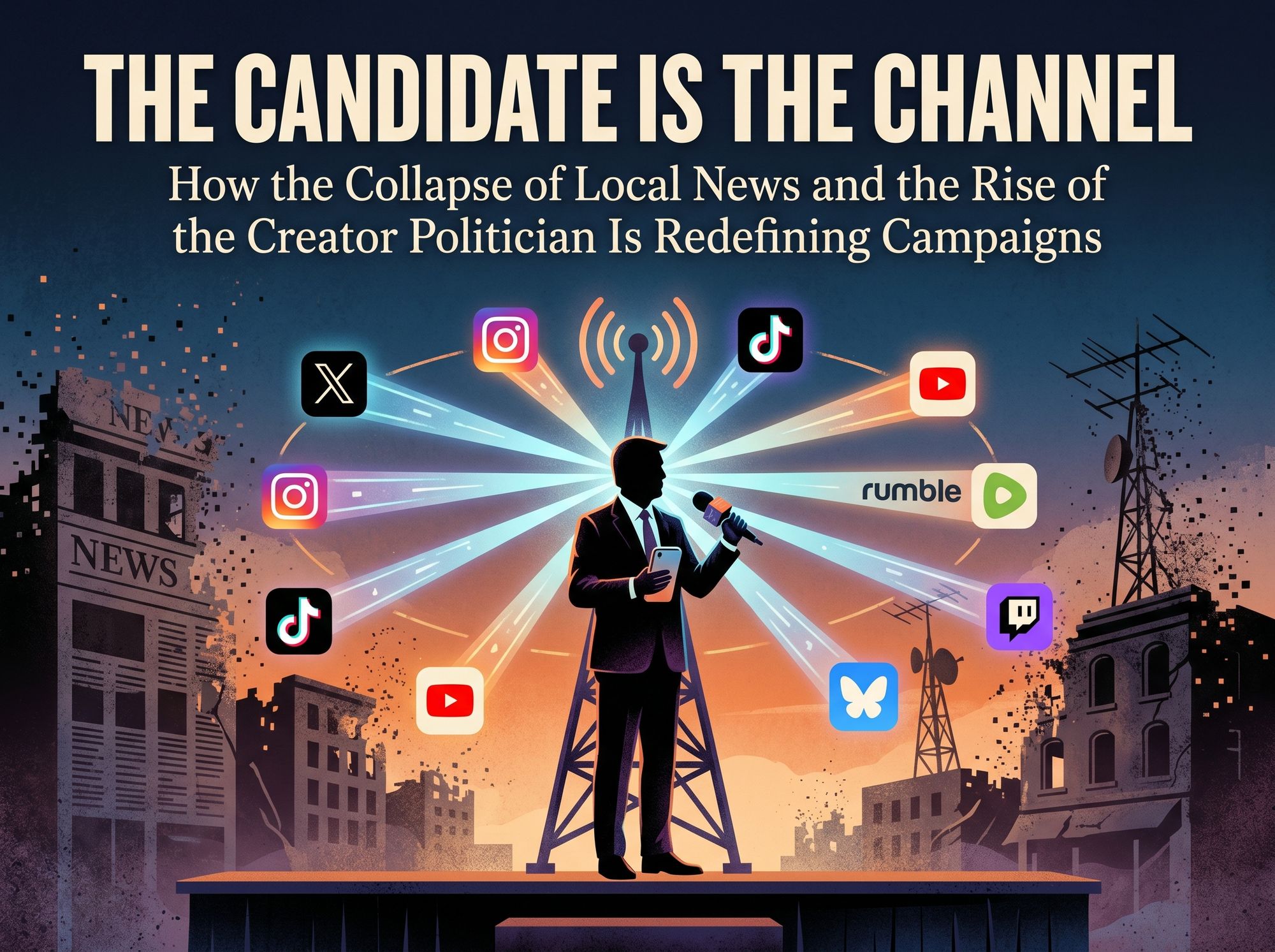
Local-news collapse and creator-economy diffusion have produced the era of candidate-owned channels
Potential 2028 U.S. presidential candidates are operating less like party-bound politicians and more like one-person media companies. The shift rests on two structural changes pulling in the same direction: the rapid collapse of America's local-news ecosystem, which has cut off the external coverage candidates once relied on, and the spread of creator-economy infrastructure that now lets anyone build a community on a platform. With both forces converging, candidates have begun running content production lines under their own names.
An Axios analysis of potential candidates' digital footprints published May 9 shows that former Vice President Kamala Harris (카멀라 해리스, 58.2 million followers), Rep. Alexandria Ocasio-Cortez (알렉산드리아 오카시오-코르테스, 29.0M), former Fox News anchor Tucker Carlson (터커 칼슨, 37.2M), and Donald Trump Jr. (도널드 트럼프 주니어, 35.2M) have established content footholds across X, Instagram, TikTok, YouTube, Substack, Rumble, and Bluesky. Politicians are migrating from being subjects of the news to operators of channels.
How local-news collapse made direct channels essential
Christian Tom (크리스천 톰), former director of digital strategy under the Biden administration, told Axios that creating one's own social and digital content is now table stakes for anyone seeking to influence people's lives. As local newspapers folded and regional broadcasters consolidated, candidates without owned channels lost the ability to reach beyond their home district. As candidates increasingly control their own distribution, governors, senators, and House members can now build national donor networks far beyond their home states — accelerating what was once a slow nationalization of American politics.
Republicans concentrate on X, Democrats diversify
Platform distribution splits along party lines. Republican contenders have roughly half their followers concentrated on X, while Democrats spread theirs across Facebook, Instagram, TikTok, and Bluesky. Pete Buttigieg (피트 부티지지), former Transportation Secretary, has built sizable Bluesky and Threads followings, and Ocasio-Cortez is testing Twitch (트위치) livestreams alongside her Bluesky (블루스카이) presence. Trump Jr. has skipped YouTube entirely, signing a multiyear deal with conservative-leaning Rumble (럼블) in 2023. LinkedIn has not yet emerged as a presidential channel, though Maryland Gov. Wes Moore (웨스 무어) and Trump Jr. have both built substantial audiences there.
Figure 1. Platform follower share of eight leading potential 2028 candidates. Ted Cruz shows the highest X concentration at 64%, while Tucker Carlson balances X dominance with a 15% YouTube share. The four Democrats display a more even spread across X, Instagram, TikTok, and Facebook.
Substack, podcasts, merch — the multi-stack as new standard
Content formats are diversifying. Democratic contenders dominate Substack (서브스택), with Buttigieg and California Gov. Gavin Newsom (개빈 뉴섬) building large subscriber bases. Podcasting attracts both parties: Newsom, Trump Jr., Kentucky Gov. Andy Beshear (앤디 베셔), and Sen. Ted Cruz (테드 크루즈) of Texas all run shows. Merch stores serve double duty as messaging tools and revenue streams — Newsom sells products that troll President Donald Trump, while Beshear runs a podcast-branded shop. Running video, newsletter, audio, and merchandise under one name has become the multi-stack template for top-tier contenders.
Figure 2. Media product holdings across 20 potential candidates. Books are nearly universal across parties; Substack skews Democratic; podcasts and merch stores appear selectively on both sides. Gavin Newsom is the only candidate operating all four formats.
Going viral isn't winning — the backlash against overproduction
Going viral does not always translate into votes. Grace Weinstein (그레이스 와인스타인), who tracks political content for the Substack "Who Broke It," argued that candidates imitating other politicians' online styles — citing Newsom's Trump-style posts — risk failing to build durable identities of their own. Heavily produced content can also backfire: when a lawmaker's video looks meticulously polished, it signals time the lawmaker is not supposed to have. Adam Mockler (애덤 모클러), a Gen Z political commentator, warned against over-indexing on the TikTok account; the real goal, he said, is to be "so omnipresent" that supporters and creators continuously clip and repost your content elsewhere.
Variables to watch — TikTok return and candidate v
📎 Read full article on K-EnterTech Hub →
About K-EnterTech Forum · K-엔터테크포럼
K-EnterTech Forum (K-ETF, K-엔터테크포럼)은 엔터테인먼트 테크놀로지, K-콘텐츠, 한류, 미디어 정책 분야의 전문 인사이트를 제공하는 국내 대표 플랫폼입니다. K-팝·K-드라마·K-푸드·K-컬처와 AI·스트리밍·크리에이터 이코노미·방송 기술의 공진화(Co-Evolution) 전략을 연구하고, 국내외 포럼·행사를 통해 정책 및 산업 협력 의제를 이끌고 있습니다.
K-EnterTech Forum is Korea's leading platform for insights on entertainment technology, K-Content, Hallyu, and media policy — bridging Korean cultural industries with global technology trends.
고삼석 상임의장 · Chairman Samseog Ko
고삼석(Ko Samseog)은 K-EnterTech Forum 상임의장입니다. 동국대학교 첨단융합대학 석좌교수이자 국가인공지능전략위원회 분과위원으로, 30년 이상의 방송통신 정책 및 산업 경험을 바탕으로 K-콘텐츠와 글로벌 엔터테인먼트 기술의 융합을 선도하고 있습니다. 前 방송통신위원회 상임위원을 역임했으며, ZDNet Korea에 정기 칼럼을 연재 중입니다.
Samseog Ko is the founding Chairman (상임의장) of K-EnterTech Forum. He is a Distinguished Professor at Dongguk University and a member of Korea's National AI Strategy Committee. Former Commissioner of the Korea Communications Commission (KCC).
📩 familygang@naver.com | 🌐 entertechfrum.com | 고삼석 상임의장 소개 →